Dyslexia Assessment
Current Assessment Availability includes 14th August at 11am. Other summer appointment dates are also available and we are taking bookings for September.
How to Book an Assessment
- Download and complete the relevant questionnaires: (1*)
- Email it/them to us.
- We’ll review your information and answer any questions.
- If you’d like to proceed, we’ll arrange an assessment date.
- A £150 booking and administration fee secures your appointment.
(1*)For Children age 7+ complete the Family Questionnaire and ask your child’s school to complete the School-Questionnaire. For adults age 16+ complete the Adult Questionnaire 16 years +
If you’d prefer to email or discuss first: dyslexia specialist teacher (Level 7), Ruth Gravelle aims to reply to email inquiries within two working days. You are also welcome to text or call. Ruth Gravelle / ruth@rightmind.life / 07919 405 501
EMAIL UPDATE
rightmind.life recently experienced some server issues that prevented some emails from being sent or received. This appears to have resolved. However, if you have sent an email or completed the enquiry form more than 2 working days ago and not yet received a response, please get in touch by phone or text, as it is possible that I have not received your message.
Thank you for your patience and understanding.
Ruth
📞 07919 405 501
Assessment Fees and Booking
A £150 booking and administration fee is payable to rightmind.life to secure an assessment appointment. This forms part of the total assessment cost and covers the administration, information gathering, liaison and room arrangements involved in setting up the assessment. The remaining assessment fee of £450 is paid directly to the assessor. The total cost of the assessment is £600.
If We Need to Reschedule
It is rare for us to need to reschedule an assessment. However, should this become necessary, you will be offered an alternative appointment as soon as possible. Please read our full Assessment Booking Terms July 2026 before confirming your appointment.
Questions and Answers
Who conducts assessments? Assessments are conducted by qualified specialist assessors, including HCPC-registered psychologists and specialist teacher assessors holding a current Assessment Practising Certificate (APC). All assessors are experienced in identifying specific learning difficulties, including dyslexia.
Do I need to see an optician/optometrist before my assessment?How long does the assessment take and when will I receive my report? Up to 2 hours with an Educational Psychologist and Up to 3 hours with a Specialist Teacher Assessor (APC). Your written report is normally completed within 2–4 weeks.
Do I need to bring anything with me to the assessment? The person having the assessment may like to bring a drink with them. Any equipment that is used as a normal way of working (reading glasses, coloured overlays, pencil grips etc.) should be brought on the day.
Where does the assessment take place? Assessments referred through rightmind.life are usually held on the first floor at Chelmsford Counselling and Therapy Centre, 14 Wells Street, CM1 1HZ (no lift available—contact us if you require accessible arrangements). Assessments are also offered in Newark, Nottinghamshire. Adults can choose to have an online assessment, if preferred.
What kind of information and tests are used to assess for dyslexia? Your background details and referral reasons in preparation of the assessment, then we assess visual/verbal skills, processing speed, phonological awareness, memory, auditory processing, the ability to recognise and apply spelling patterns and rules for literacy, reading, writing, spelling, handwriting, and fine-motor skills.
Can the person having an assessment have a parent or friend with them during the assessment? No. Assessment appointments are one to one as having another person in the room influences the test performance and outcome. At Chelmsford, there is a waiting area, where one parent/guardian is welcome to wait.
What if English is my second language? The independent assessors who work in association with rightmind.life may be able to offer you an assessment if English is your second language, or you may be advised to contact the British Psychological Society (BPS), who have a register of multilingual psychologists: https://www.bps.org.uk/public/find-psychologist
Will I definitely get a diagnosis of dyslexia if I have an assessment? No, although dyslexia is very often diagnosed as an outcome of an assessment. When dyslexia is not identified, the report findings can provide helpful insight of the learners educational profile, and to plan education/support needs.
What are the benefits of having a diagnostic assessment? A diagnostic assessment helps parents, children, and adults understand learning strengths and challenges. An assessment report evidence for exam access arrangements (subject to school or college procedures), and provides personalised recommendations for learning, study, wellbeing and work. An assessment can be used to support applications for Disabled Students’ Allowance (DSA) in higher education, and help employers make appropriate workplace adjustments.
What other types of assessment are available?
We also offer non-diagnostic assessment, known as a Screening Assessment which costs £350 and is available for children aged 5+ to adult, with mini report and recommendations. The assessment includes tests for language, phonological awareness, processing speed, orthographic processing and reading. The appointment should take no more than an hour. This is a mini-assessment/screener, not a dyslexia diagnostic report; it includes a short report of several pages, with suggested interventions.
Online Workplace Needs Assessment are also available for adults with neurodiversity (including dyslexia, dyscalculia, dyspraxia, ASD and ADHD). You don’t need to already have a formal diagnosis in order to have a workplace needs assessment. The cost of a Workplace Needs Assessment is £600
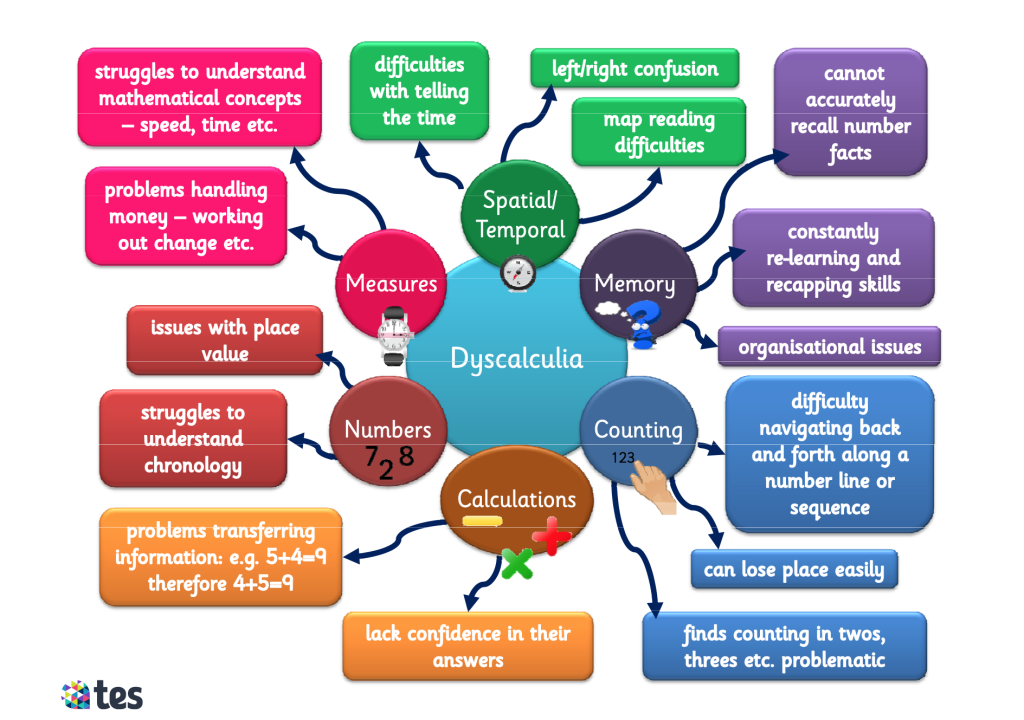
Dyscalculia Assessment – A regular dyslexia assessment can include, upon request, some maths testing to highlight maths issues but does not diagnose dyscalculia (cost £600) . The assessment usually takes up to 3 hours.
Diagnostic assessment for dyscalculia – If a student is only showing maths issues, some literacy assessment is still required. The assessment is conducted over two sessions of approximately 3 hours each and is suitable for learners aged 9 years and over who have ongoing difficulties with mathematics despite intervention to address them. The total fee for this type of assessment starts at £700. We need to evaluate your background information before quoting the exact cost.
A Dyslexia and dyscalculia assessment is carried out over 2 appointments – up to 6 hours assessment in total. The total fee for this type of assessment is £830.
Dysgraphia can be identified with a dyslexia assessment. Not all assessors use the term dysgraphia, they do however describe the handwriting issues identified and make recommendations.
Additional learning differences – Neurodiversity
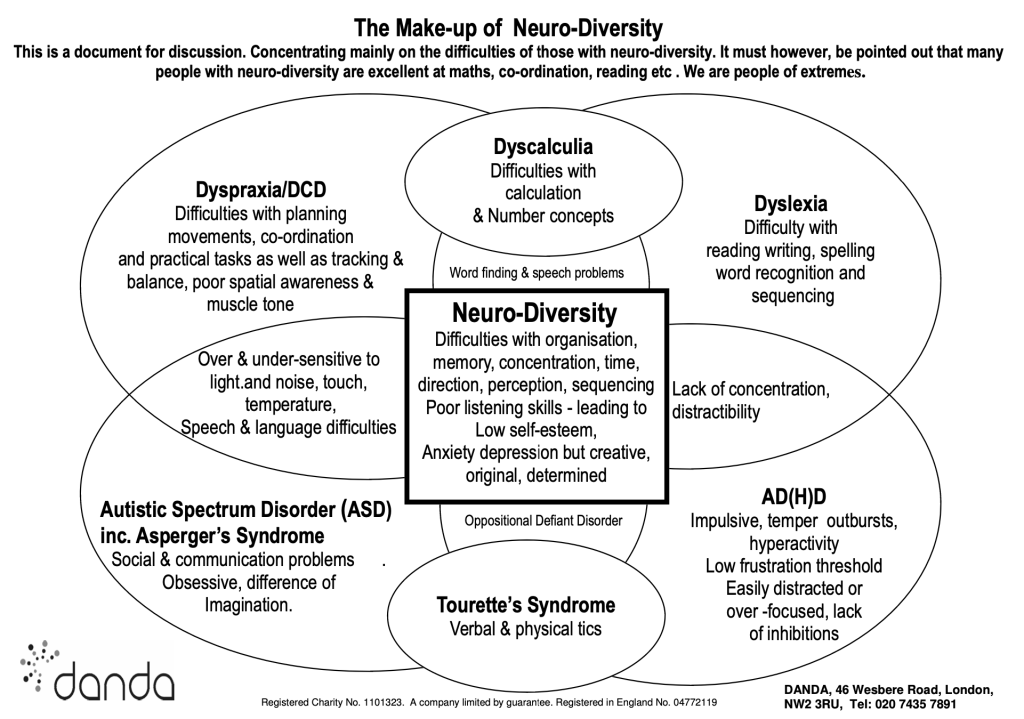
Dyslexia is sometimes described under the heading of Neurodiversity. The Make-up of Neuro-Diversity diagram is intended as a discussion tool and refers to adults, but may be of wider interest.
If you suspect that your child may be on the autistic spectrum, experience dyspraxia (DCD) or ADHD, you are advised to contact your GP who can make NHS referrals via the medical route Alternatively, you can contact the British Psychological Society (BPS), who have a register of multi-disciplinary psychologists who can provide a more in depth specialist assessment: https://www.bps.org.uk/public/find-psychologist The Association of Child Psychologists in Private Practice – AChiPPP, also have a register of child psychologists, some of whom offer in depth specialist assessments: http://www.achippp.org.uk
The Delphi Definition of Dyslexia (2025)
For over 150 years, dyslexia has lacked a universally accepted definition between the various experts in different fields (educational, medical, psychosocial). The Delphi definition method offers a structured expert consensus process and was led by Julia Carroll (University of Birmingham) with SASC, King’s College London, and Oxford, and published in the Journal of Child Psychology and Psychiatry on February 25th. Carroll’s team gathered 58 international experts to vote on statements about dyslexia’s definition, abilities, causes, related conditions, lifelong effects, and misconceptions; 42 statements with over 80% agreement shaped this new definition (description):
- Dyslexia is a set of processing difficulties that affect the acquisition of reading and spelling.
- In dyslexia, some or all aspects of literacy attainment are weak in relation to age, standard teaching and instruction, and level of other attainments.
- Across languages and age groups, difficulties in reading fluency and spelling are a key marker of dyslexia.
- Dyslexic difficulties exist on a continuum and can be experienced to various degrees of severity.
- The nature and developmental trajectory of dyslexia depends on multiple genetic and environmental influences.
- Dyslexia can affect the acquisition of other skills, such as mathematics, reading comprehension or learning another language.
- The most commonly observed cognitive impairment in dyslexia is a difficulty in phonological processing (i.e. in phonological awareness, phonological processing speed or phonological memory). However, phonological difficulties do not fully explain the variability that is observed.
- Working memory, processing speed and *orthographic skills can contribute to the impact of dyslexia.
- Dyslexia frequently co-occurs with one or more other developmental difficulties, including developmental language disorder, dyscalculia, ADHD, and developmental coordination disorder.
*Orthographic skills are the ability to recognise and apply a language’s spelling patterns and rules for reading and writing. These skills help us connect sounds (phonemes) to their corresponding letters (graphemes) and store words in memory for quick recognition).
Counselling and/or Hypnotherapy to cope more easily with dyslexia?
“Not everyone struggles with dyslexia, but those who do often respond with/experience fear, stress and/or shame, often hiding their difficulties with feelings such as inadequacy, low self-esteem and negative self-talk. The good news that these responses can be turned-around. If you identify with this type of description, therapy can absolutely help. Limiting beliefs can be stopped and acknowledging individual strengths is also important. Just talking about this is a good starting point. While every person is different and outcomes cannot be guaranteed, many clients report feeling more hopeful, confident, and understood after their first session.” Ruth Gravelle
Positive Dyslexia Mindset
“There is no shame in spelling mistakes” (Ruth Gravelle). Research shows that people with dyslexia “…have a unique brain structure and organisation, with some different brain strengths” (Eide and Eide, 2011). Many have excellent skills in visual thinking and visual technologies, and they have a highly creative potential (West, 1991/2009). Social, cognitive and work related strengths have also been identified, as well as a strength in unconventional thinking, which are, “…precisely the skills needed for individuals and organisations to flourish in the 21st Century” (Nicholson, 2015).
We need to identify and nurture our strengths!
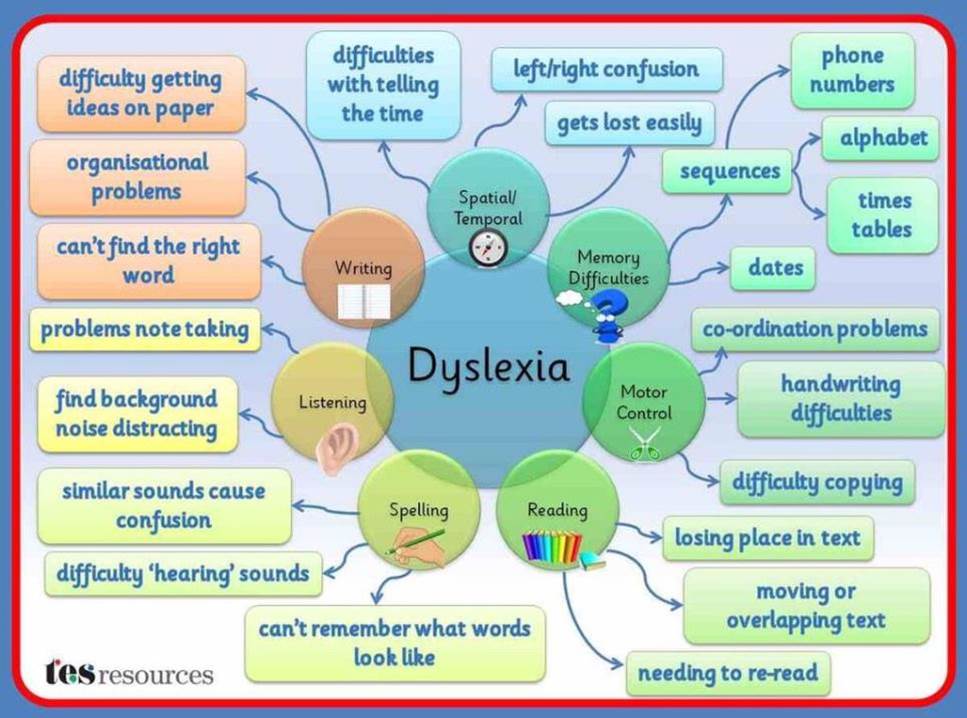
Whilst dyslexic people have many strengths, the diagram below (tes resources) provides a snapshot of the types of difficulties you may observe in dyslexic children. This diagram could be used as a starting point to identify where changes to teaching and learning are required. For example, if a child is struggling to learn the 10+ weekly spellings routinely given at school, reduce them to perhaps 3-5 spellings a week to enable them to learn spellings in a structured, cumulative and multi-sensory way, incorporating their strengths.
Dyslexia, and other specific learning differences need to be taken seriously and managed carefully. The danger of children ‘failing to learn and learning to fail’ (Nicholson, 2015) makes safeguarding them from “toxic learning experiences” an absolute priority. We must quickly notice the children who are struggling and enable them.
Assessment from the age of 7 years and a carefully developed Individual Learning Plan is recommended. We need to help people to become better at being dyslexic (Eide and Eide, 2011), to identify and remove dyslexia related stressors and to find skills and strategies that enable them. Multi-sensory teaching methods, Apps and exercises for ‘brain training’, breaking things down into small manageable chunks, support with homework, organisation, memory, reading, reducing weekly spellings and assisting children to find strategies can all help. Most of all, we need to help them recognise, celebrate and work with their strengths; the world needs people with different strengths.
Nicholson (2015) states that,”Dyslexic children of 5 years are not reading ready”, and a body of research has found that all children under 7 years old learn best through play, not just the dyslexic ones! Upstart (www.upstart.scot) is an organisation campaigning for all children in Scotland to delay formal education until the age of 7 years, with a statutory play-based ‘kindergarten stage’ in early years. Would you like to see this change in the UK too? “Childhood is not a race!” The under-sevens need “PLAY NOT TESTS” (Upstart)!
Ruth Gravelle’s 30 minute talk, “Positive Dyslexia and a New Approach to Education” https://www.youtube.com/watch?v=Ab4-2QZti0A introduces dyslexia, and what is meant by ‘Positive Dyslexia’. A new approach to education is proposed for the UK to better enable all learners, not just those with dyslexia. Please contact Ruth through www.rightmind.life if you would like her to speak at an event.
Tuition, Study Skills and Confidence Boosting
In person or online one-to-one multi-sensory tuition, study skills and confidence-boosting is available with dyslexia specialist teachers. We support children, young people, adults including university students and people at work, assisting you to:
- Identify personal strengths and find your best ways of learning/working
- Develop reading, spelling, memory and organisational skills
- Use technology which supports reading, writing, spelling, memory and organisational skills
- Make sense of the learning difference experienced
- Cope more easily at school, home, university, in the workplace and socially
- learn to revise using the most effective methods for you
- Increase confidence and self-esteem
Free Dyslexia Advice
Not sure whether an assessment is needed?
Book a free 30-minute phone or online advisory appointment with Ruth Gravelle.
- No obligation
- Professional guidance
- Support for children, young people, and adults
📧 ruth@rightmind.life
📞 07919 405 501
Vision and Dyslexia
We ask that children being assessed for dyslexia have had their vision tested within 24 months of the dyslexia assessment. If you often experience visual difficulties when reading such as: seeing two of each word, words appearing blurry, unclear or moving about on the page, or if your eyes become sore or water or irritated in some other way, or if reading for more than a few minutes results in a headache, we may recommend that you see a behavioural optometrist, or an optometrist to assess for visual stress/scotopic sensitivity (also called Meares-Irlen Syndrome).
Optometrists with a specialist in the scotopic sensitivity and other visual issues that can influence learning in Essex include:
- Charlotte Wearmouth, Optometrist: www.patrickandmenzies.co.uk at Braintree
- Vik Juggessur, optometrist: www.chelmservillageopticians.co.uk at Chelmsford
- Dr Annette Grounds, Behavioural Optometrist: at Tiptree
- Dr Claire O’Leary/Anita Shared: Optometrists: www.cmt-optometrists.co.uk at Shenfield, Brentwood
-
Perfect Vision Opticians: at Hullbridge SS5 6EX.
Families in Focus
For your information, if a young person in your family is struggling to cope with a particular change, challenge or crisis, Families in Focus may be able to support you. This organisation is “…a parent led registered charity providing holistic support to families of children with disabilities and special needs (aged 0 to 25) across Essex, who require advice, information and support, particularly at times of change, challenge and crisis.” http://www.familiesinfocusessex.org.uk.
Independent Advice: IPSEA to access resources and free independent legal advice: https://www.ipsea.org.uk/Pages/Category/what-we-do
Testimonials
Hi Ruth, I just wanted to say thank you for all the time and effort you have given Ben over the past year. He has come along leaps and bounds and I know it hasn’t been easy. We will continue with Starspell and would love to work together again. I think revision classes would be very beneficial for Ben as he struggles to retain information so this would be great! Many Thanks, Sam
Parent, 2023
Thank you, F has really enjoyed the sessions she has had with you and it has given her some great tools to work with going forward. Your sessions have really helped her though and she is a lot more confident especially in the revision side of things. She is making maps, plans, charts etc where she didn’t even know where to start before.
Hi! I wanted to write and give my praise and appreciation for my Study Skills Tutor, Ruth Gravelle. Her understanding of the difficulties and advantages of being Dyslexic was a breath of fresh air. She was able to think outside the box and suggest a variety of ways of approaching studying, revising, and academic study skills in an uncommon specific medical area at MSc level, where others would use that as their excuse to not be able to help me. She was also very supportive during the stressful exam periods and always left me feeling motivated and inspired to study. Her disposition is always happy, positive, encouraging, and understanding. Without a doubt the best support I have received in further education. This was all achieved remotely through Zoom sessions. Alison.
Postgraduate student, July 2020
Feedback from parent following 3 sessions
Hi Ruth… Happy New Year. M has been doing really well on her revision these last few weeks and has got into a really good rhythm. I am very proud of her… She is creating the flash cards to revise and has just got on with it with confidence she did not have before. I will keep you posted. Thank you for all your help to date – you have been a star.
A parent, January 2020
Letter to Dr Sue Warnock:
“…I just wanted to pass on our huge appreciation of helping us understand D and how best we can help him. We now have a framework through which to have structured and supportive conversations, rather than the lazy, immature perception that we’ve struggled with.
We can also now understand why D says “nobody believes me anymore” and he becomes extremely frustrated when he tries to explain why he can’t produce written work, follow instructions or do physical movements, despite seeming to be a capable and bright boy. It broke my heart when he got his year 4 report and he cried and said “mummy, it’s not very good but I don’t understand why, I have tried really hard”. Bless him …… this must be incredibly frustrating!
We are feeling positive that we can provide the support he needs and hopefully with techniques and coping mechanisms there are practical ways to improve his ability to convey his brightness in his school work and progress tests so will be in a better place for his upcoming 11+ common entrance exams later this year…”
– A Parent, January 2019
“Ruth has worked with my son who is diagnosed with dyslexia and was a reluctant reader and writer. Since working with Ruth he has blossomed into a learner who is engaged, curious and willing to give reading and writing his best shot. Although he still struggles to get his ideas written down he is much more confident in giving it a go and is able to see the benefits of doing so, which is fantastic to see. Ruth has also worked on improving his memory and recall skills and he is now confident in applying these techniques to all aspects of his learning.
Ruth has provided regular updates and always delivered well planned lessons with a great variety of resources. Ruth’s passion for making learning fun and meaningful has enabled my son to become an independent reader and writer.”
– Becky (Primary Teacher), 2018
“We do the letter arc, reading, spelling, memory games, computer work and drawing. The lessons are fun. Ruth is a very kind and good teacher.”
– Joseph, age 7, 2017
“Ruth has helped me to gain confidence and find practical solutions which have made a real difference, especially with coping at work…”
– Jack, Social Worker, 2017
“Ruth Gravelle has helped me to overcome aspects of my disability that in the past held me back in my education and employ-ability. The educational support and positive psychological input has helped me in the last 6 years to graduate from two universities, and has given me a positive outlook to living with dyslexia.
I am currently working full-time as a Counsellor at a hospice.”
– Graduate (DSA), 2015
Previous Events
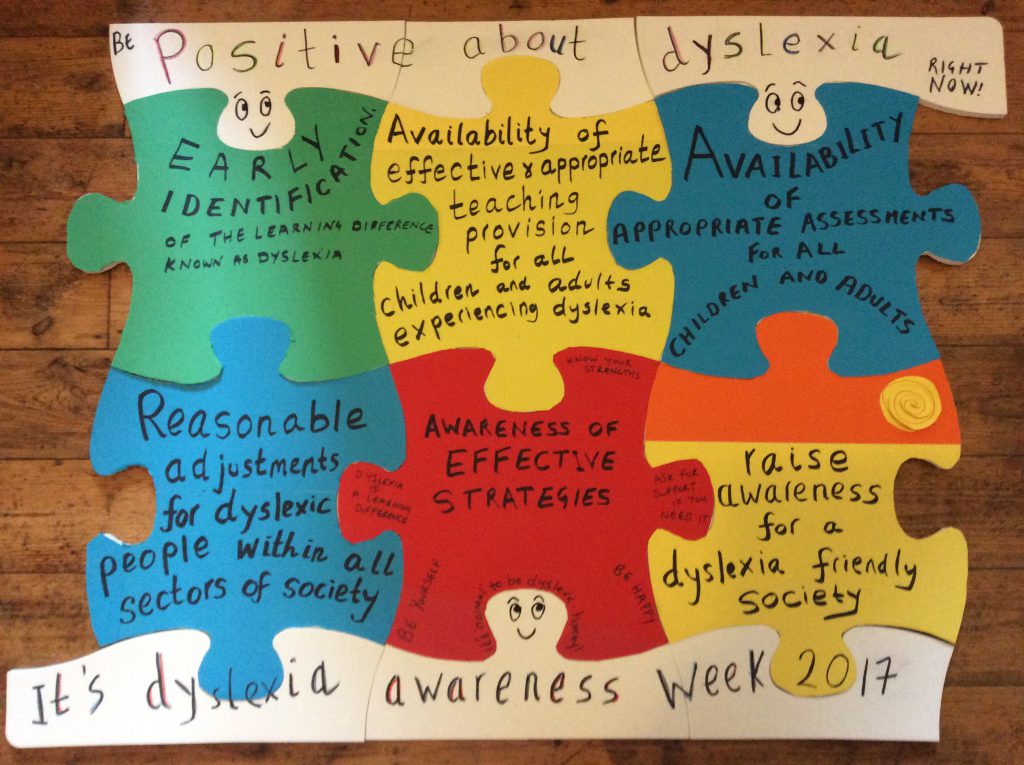
During dyslexia awareness week 2-8 October 2017 rightmind.life provided an information display in the covered area just outside Chelmsford Central Library. This is all as relevant now as it was in 2017!
On 1 October 2017, Chelmsford Community Radio’s LIfe Matters show (104.4fm) discussed dyslexia. Ruth Gravelle interviewed Jared Bates and Marilyn Smith. You can listen to this show again here (link to follow).
We support The British Dyslexia Association theme of “Positive about Dyslexia”
Addressing the Strengths and Challenges of Dyslexia
Wednesday 7th November 2012 – Dyslexia Rooms Talk
Ruth Gravelle from Dyslexia Rooms returned to SNAP to give a talk on addressing the strengths and challenges of dyslexia. The talk included an overview of dyslexia, consideration of perception and the identification of the strengths and challenges, which children and young people with dyslexia face. Ruth offered support and guidance to parents and discussed a variety of strategies, which they can use to try and help their children.
“It has given me as a parent a better understanding of what my daughter is going through.”
“The talk gave me a better understanding of different ways dyslexia affects individuals and how to be more considerate towards their needs.”
“It was helpful in reminding me that there are so many strengths and that I should be focusing on them rather than the weaknesses and challenges.”